
02 Nov How to Use Professional Photography & Video to Win More Listing Presentations
| TL;DR: The agents who win listing presentations increasingly aren’t the ones who talk about their marketing, they’re the ones who turn up with an actual photo and video sample from that specific property already made. That only works if your photographer can turn a shoot around fast enough to fit before the meeting. The most useful real estate listing presentation tips hinge on one key shift: stop promising good marketing and show it, before the seller has signed anything. |
Most agents pitch their marketing the same way, offering professional photos, a video, good coverage on the listing sites, along with a host of other promises. And while those promises are perfectly reasonable, the only problem is that the seller has heard all of it before.
None of these promises actually prove anything, because you are asking the seller to trust a description of work that doesn’t exist yet. The usual fallback is to show examples from other homes you may have sold (which is better than nothing), but it still says here’s what I did for someone else.
Show, Don’t Tell
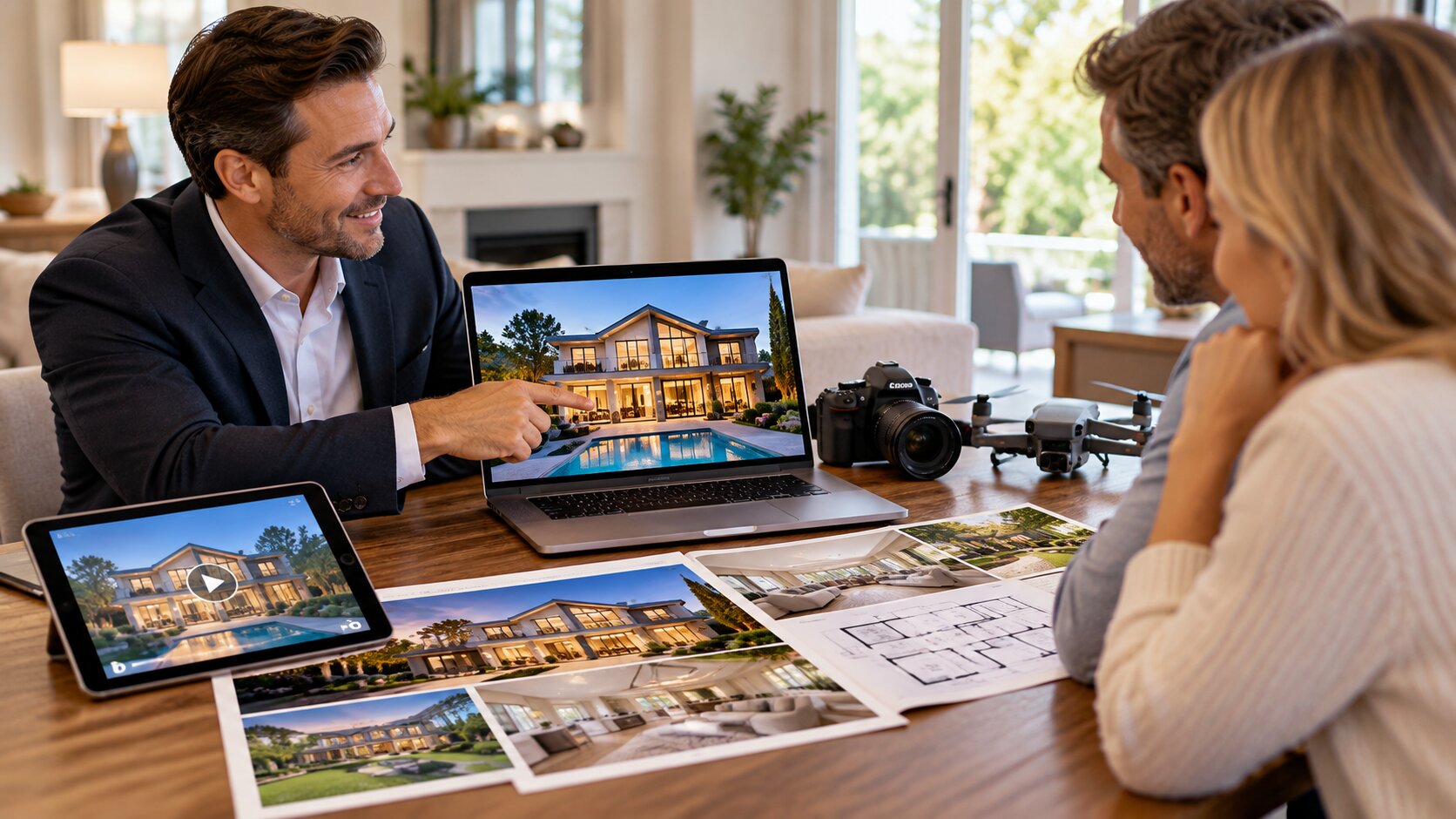
You can probably see the issue here – It never quite answers the question the seller is truly asking, which is what their house will look like. But there is a way to answer that question directly, and, rather oddly, almost nobody does it. You simply show up with real photos and video of their home, shot that week.
The rest of this blog post covers how that works and when it’s worth doing. These are the real estate listing presentation tips that change the meeting rather than dress it up, and you will see the benefit once you build them into your strategy.
Key Takeaways
- Sellers respond to seeing real photo and video of their own home far more than to claims about professional marketing.
- A fast turnaround, roughly 24 to 48 hours, is what makes a sample shoot before the meeting possible rather than theoretical.
- A bundled shoot, photos plus video plus drone plus floor plan in one visit, gives you a finished real estate marketing plan for sellers to show instead of a few loose images.
- It’s worth doing for competitive listings where you’re up against other agents. It’s an edge for the pitches that matter, not a routine for every appointment.
Why “We Use Professional Photography” Isn’t Enough Anymore
Saying you use a professional photographer used to set you apart from the competition. It doesn’t now, because every agent says the same thing. It’s the expected standard, not a unique selling point, and a claim every competitor is making word for word isn’t going to guarantee new business.
The seller can’t tell two identical promises apart, so when you say “I use professional photography” and so does the agent before you, there is nothing in that for them to choose on. Essentially, you are both asking for the same thing, which is for the seller to take your word for a result they can’t see.
This is where most real estate listing presentation tips tend to fall short, but a finished sample from their actual property solves the problem, because it’s no longer a claim.
The photography services you would deliver after the contract is signed are sitting on the table, and the seller can look at their own home instead of imagining it. That’s the difference between the two pitches: one describes the work, the other is the work. It’s most of what decides who walks away with the listing.
What to Bring Into a Listing Presentation

You don’t need much. A few strong, finished pieces beat a folder of everything, so keep it nice and tight.
- A short video clip of the property. Fifteen to thirty seconds of their own home does more than any photo, and it’s the thing competitors almost never have, because it needs a quick turnaround to exist before the meeting.
- Three to five of your best photos. The exterior, the main room, and a couple of spaces with character. Enough to set the standard, not so many that it turns into a slideshow.
- An aerial shot, if the lot or location deserves one. A big lot, a view, a spot near good schools, these read from the air and nowhere else. Leave it out for a townhouse with nothing outside to show.
- A floor plan, if the layout is a strength. An open first floor or a smart addition makes more sense as a plan, and including one tells the seller you have thought about how buyers actually search.
Put them in front of the seller and let them look. That usually does more than anything you had planned to say, which is really the key factor for how to win a listing presentation when you are up against other agents.
How a Pre-Presentation Shoot Actually Works
The first objection most agents raise is logistics, since fitting a shoot in between agreeing to pitch and sitting in the seller’s living room sounds unrealistic. In practice it comes down to turnaround time, and the process is simpler than it first appears:
- Book the shoot as soon as the appointment is set. The earlier it goes on the calendar, the more room the photographer has to fit it in before the meeting.
- Let the photographer shoot the property. Most residential sessions take an hour or two on site.
- Expect the files back within a day or two. A 48-hour turnaround makes the approach practical, whereas a week’s wait rules it out completely.
- Put video near the top of the list. Short real estate videography gains the most from that speed, since it’s the asset no rival agent will have had time to produce.
- Know your minimum if time is tight. One strong exterior or hero shot and one short video clip do most of the work on their own.
That speed is often what decides how to win a listing presentation against an agent who looks stronger on paper. Plan around the minimum, treat everything else as a bonus you add when the schedule allows, and the whole thing stops feeling like a stretch.
When This Is Worth the Extra Step (And When It Isn’t)

Of course, this approach isn’t for every appointment, and treating it that way would cost you time and money for no reason. It pays off in specific cases, but certainly not all.
Use it when you know several agents are pitching, when the listing is valuable enough that winning it covers the cost, or when the property has a real visual draw that a stock example can’t match. A large lot or a striking exterior is where drone photography turns a decent pitch into one the seller remembers. In those meetings, a sample from the actual home is often what tips the decision.
When there is no competition, or the listing is modest, and the numbers don’t add up, your usual portfolio and a solid pitch are fine. Treated as part of a wider real estate marketing plan for sellers, the sample shoot becomes the proof that makes the rest of your promises believable. Knowing how to win a listing presentation is partly knowing which ones are worth this and which aren’t.
Book a Shoot Before Your Next Listing Presentation
Next time you have a competitive pitch booked, treat the sample shoot as part of your real estate marketing plan for sellers rather than an afterthought. Book the property, get the files back inside two days, and walk in with the one thing no other agent thought to bring.
Remember, showing beats a promise, so book a shoot with Anthony before your next listing presentation and let his work make the case for you.
FAQ
Do I need a full shoot before every listing presentation?
No. Save it for competitive pitches, higher-value listings, or homes with a real visual hook. For routine appointments, your normal portfolio and pitch are enough. The point of these real estate listing presentation tips is choosing your moments, not shooting everything.
How fast can I realistically get photos back before a pitch meeting?
With a 24 to 48-hour turnaround, you can book the shoot once the appointment is set and have the files in hand before you walk in. That speed is the thing that makes the whole approach work.
What if the seller hasn't agreed to list with me yet? Can I still get a shoot done?
Yes, and that’s the point of it. The sample exists to help you win the listing, so it’s made before any agreement, as part of the pitch rather than after it.
Does this work for lower-priced listings, or just competitive and luxury ones?
It works best where the stakes justify the cost, which usually means competitive or higher-value homes. On cheaper listings the maths is tighter, so weigh what the shoot costs against how much you want the instruction.
What should I capture if I only have time for one or two things?
One strong exterior or hero image and one short video clip. A floor plan is the easy next addition when the layout is a real selling point, and you’ve got the time.

Sorry, the comment form is closed at this time.