
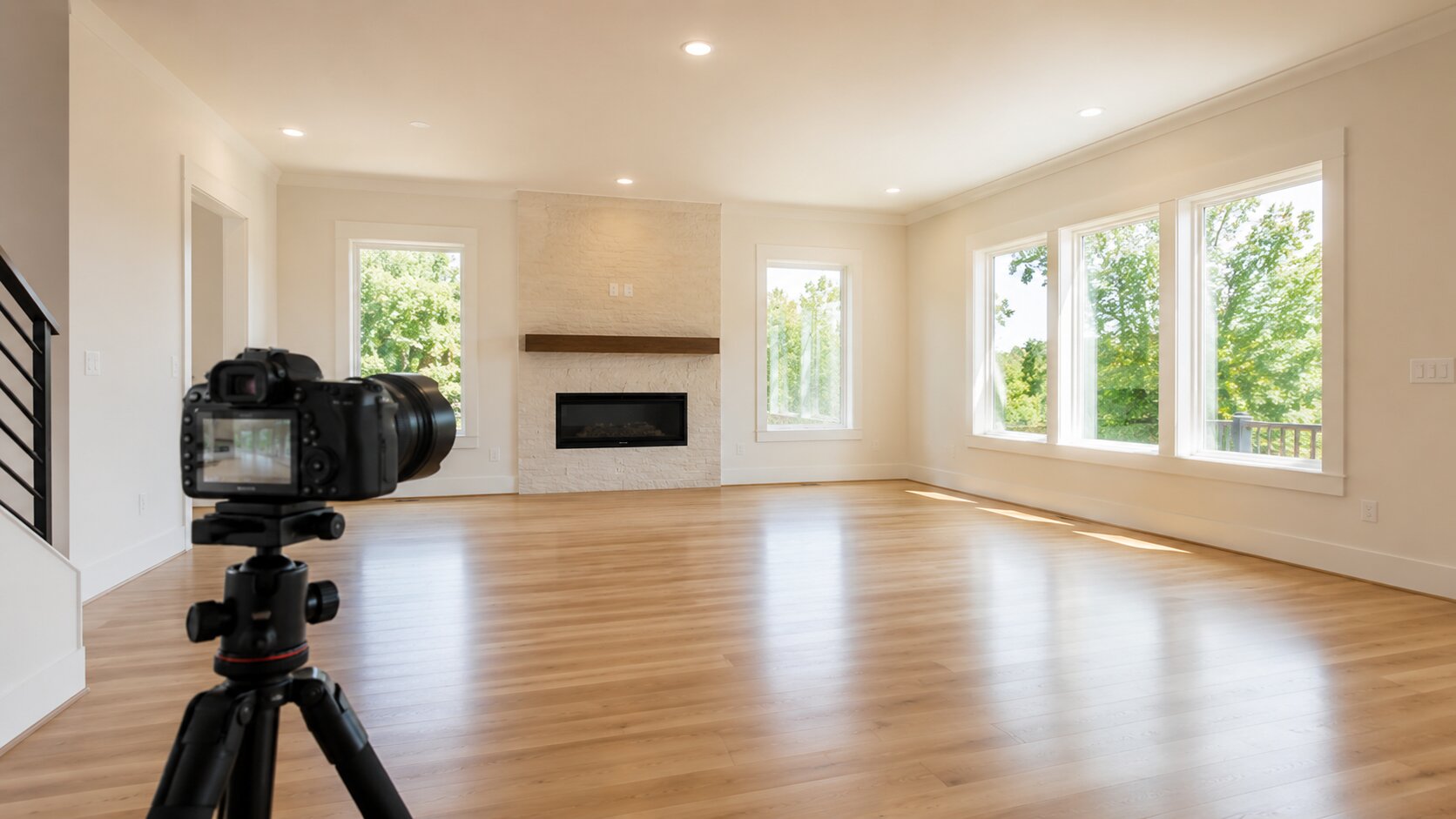
02 Nov Vacant Home Staging: How to Prepare an Empty Listing for Photos
So, you have taken on a vacant listing and the shoot is booked. Maybe it’s new construction, or maybe the sellers have already cleared out, but either way you’re marketing a home with nothing in it, and that’s a far harder job than it sounds.
The issue is that an empty house doesn’t photograph like a furnished one. The instinct to assume less stuff means less to prepare is exactly backwards, because a bare property needs more attention before the camera arrives, not less. There’s nowhere for a flaw to hide and nothing to help a buyer feel the size of a room.
But vacant home staging, done well, is what bridges that gap, and most of it comes down to preparation rather than furniture. Here’s how to get an empty listing ready to photograph so it sells rather than sits.
Key Takeaways
- Empty rooms show scuffs, stains, and uneven paint far more visibly than furnished ones.
- Buyers struggle to judge room scale with no furniture for reference.
- Virtual staging fixes the scale problem for key rooms without furnishing the home.
- A same-day walkthrough catches avoidable problems before the camera arrives.
Why Vacant Homes Photograph Differently
An empty room asks the camera to do something a furnished one never does: sell a space with no help from its contents. Take away the furniture and a buyer loses every visual cue they might normally use to size a room, so a wide living room can flatten into something ordinary and a well-proportioned bedroom can read as a box.
The problem is that nothing on the floor gives their eye a sense of scale.
Bare rooms are unforgiving in a second way. Furniture hides a lot of small sins, and with it gone, a scuffed baseboard, a hairline crack, or a patch where the paint doesn’t quite match all step into full view. The camera finds them even when a casual walkthrough wouldn’t.
Then there’s the feeling. A home stripped of soft furnishings can photograph flat and chilly, all echo and hard edges, and that emptiness quietly tells a buyer to keep scrolling instead of booking a showing.
Pre-Shoot Checklist for a Vacant Listing
Most bad photos of empty homes trace back to something small and preventable. Knowing how to stage an empty house for the camera is mostly a matter of method, so run this checklist before the real estate photographer arrives, ideally the same day, and you remove almost all of the usual problems:
- Clean every surface and floor. Dust, cobwebs, and marks on the floor read loudly in an empty room. Vacuum, mop, and wipe down.
- Turn on all the lights. Every fixture, every room, closets included. Consistent light stops rooms photographing as dim or patchy.
- Open all blinds and curtains. Natural light fills a space and shows off the windows and views. Let it in.
- Remove trash, debris, and signs. Clear stray boxes, cleaning supplies, and any for-sale or lockbox signage from rooms that will be photographed.
- Check for touch-up paint. Look for scuffs and chips at eye level and along baseboards. A quick touch-up is cheaper than a retouch.
- Secure and lock up before you leave. Confirm windows are shut, doors lock, and the home is safe once the shoot wraps.
Physical vs. Virtual Staging for Vacant Homes
If some rooms will stay empty, you have two ways to solve it. Physical staging brings in real furniture, which looks authentic in person and helps at showings, but it costs more and takes time to arrange and remove. Virtual staging adds furniture digitally to the photos, which is faster and far cheaper and solves the scale problem in the images buyers see first, though it only exists on screen.
Most agents weigh cost and speed against in-person authenticity and land somewhere between the two depending on the listing. This post is about prepping the shoot, so it won’t relitigate the whole decision here.
| ℹ️ For the full comparison, see our guide on whether virtual staging is worth it. |

Which Rooms Benefit Most From Virtual Staging When Vacant
You don’t need to stage every room, and spending on all of them is wasteful. When you work out how to stage an empty house for sale, the smart move is to focus on the spaces where scale is hardest to read empty.
The primary living areas and the main bedrooms are where a buyer most wants to picture their own life, and where an unfurnished floor gives them the least to go on, so those are the rooms that gain the most from staging.
Kitchens and bathrooms are a different matter. Their fixtures, counters, cabinets, and tubs already tell the buyer what the room is and roughly how big it is, so they rarely need staging to make sense. Put your staging budget where the empty space actually costs you.
See Our Virtual Staging Options
A vacant listing can photograph beautifully with the right prep, and for the rooms that stay empty, virtual staging fills the gap without the cost of furniture. At Home Media offers virtual staging options that turn empty rooms into spaces buyers can picture living in, worked into the same shoot, so the whole listing is handled in one visit.
Interested? Send Anthony the property details and which rooms you’d like staged, and he’ll have the shoot and the staging sorted before your listing goes live.
Frequently Asked Questions
Do I need to stage every room in a vacant home?
No. Concentrate on the living areas and bedrooms, where scale is hardest to judge without furniture. Kitchens and bathrooms usually read fine on their own.
Can photos be taken before the home is fully cleaned?
Yes, but it’s a bad idea. Empty rooms show dust and marks clearly, and cleanup after the fact means paying for retouching that a mop would have prevented. Clean first.
Is virtual staging enough, or should I physically stage?
It depends on the listing and your budget. Virtual staging solves the scale problem in the photos cheaply and fast; physical staging helps at in-person showings too. Many agents use virtual staging alone for listings that photograph well empty.
How far in advance should I do a walkthrough before the shoot?
The same day, as close to the shoot as you can manage. A final pass catches lights that were switched off, a door left open, or debris that appeared since your last visit.

Sorry, the comment form is closed at this time.