
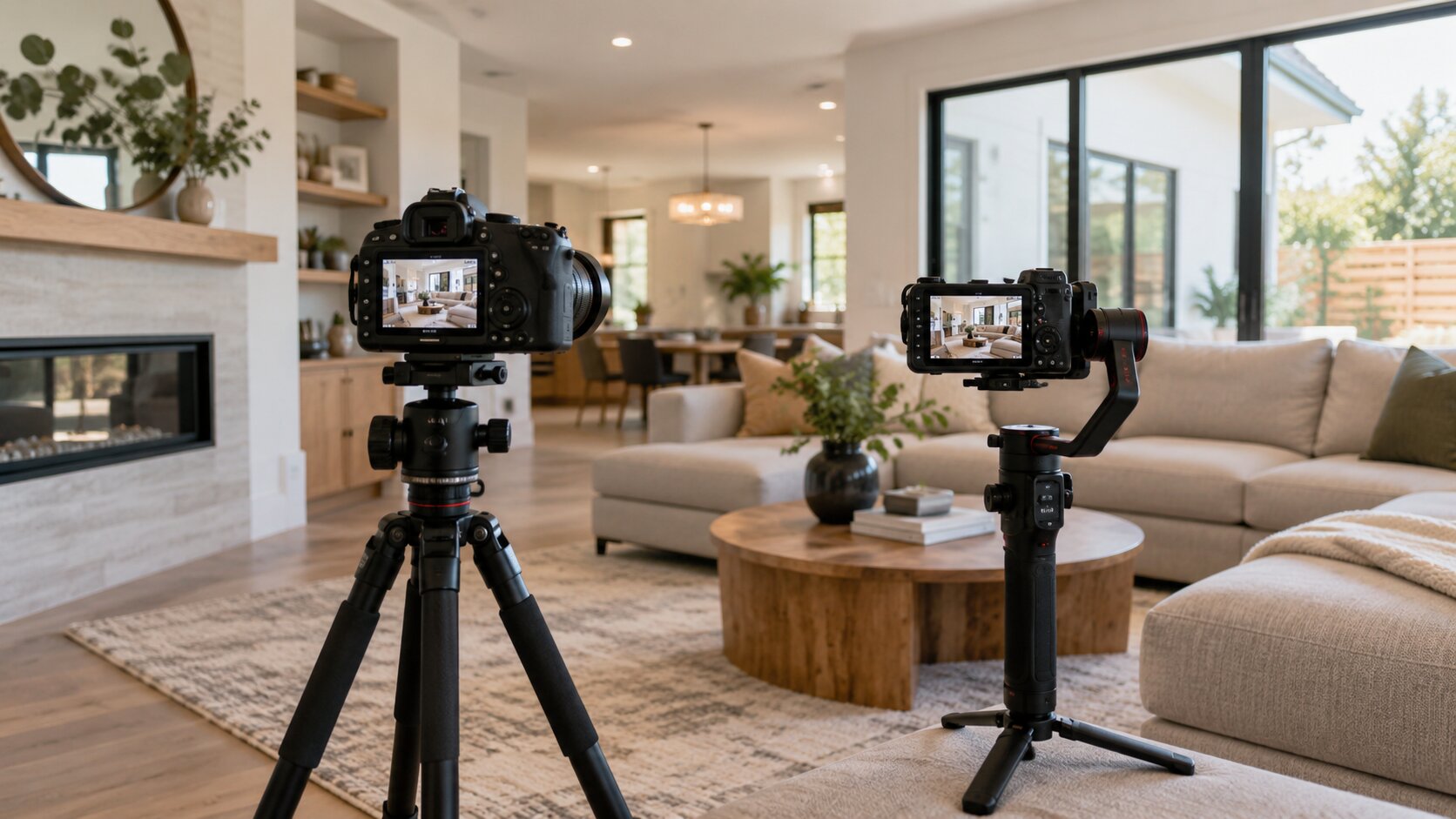
02 Nov Choosing Between Photos, Video, or Both for Your Listing
| TLDR: Photos and video do different jobs for a listing. Photos are what the MLS and most listing portals actually require, and they are what buyers scan in seconds to decide whether a property is worth a closer look. Video shows flow and scale in a way a still image can’t, which counts for more on a larger or more distinctive home than on a standard starter. The real question is not which is better, but what this particular listing needs. |
Most advice on real estate video vs photography focuses on your budget as the prime driver, and while that is true to a point, it overlooks the part an agent actually needs, which is how the property itself should steer the call.
The fact is that a compact two-bedroom condo and a rambling five-bedroom with a view don’t ask the same thing of your marketing. One is served well enough by a strong set of stills, while the other loses something the moment you try to flatten its space onto a single frame.
Rather than a blanket rule in terms of real estate video vs photography, here is a way to match the media to the home in front of you.
Key Takeaways
- Every listing needs photos. They are the baseline for the MLS and nearly every portal a buyer will use.
- Video adds the most when a property’s flow, scale, or movement through space is part of the appeal, so open layouts, unusual architecture, and larger homes gain the most.
- Video also counts for more on social platforms like Instagram, TikTok, and YouTube than it does on the MLS itself.
- Budget and price point are real factors, but the property’s own characteristics should carry just as much weight in the decision.
- Both can be captured in one shoot, which takes the pressure off the close calls.
What Photos Do That Video Doesn’t

Photography is the part of your listing that simply isn’t optional. The MLS and the major portals are built around still images, with set slots for a gallery and none for a hero video, so without photos you don’t have a listing the systems will even display properly. That answers the first half of the decision before the budget even comes into it.
Stills also suit the way buyers behave on a results page, as someone scrolling thirty listings over morning coffee gives each one a few seconds, and a clean lead photo is what earns the click or loses it. Strong photography services front-load that first impression and hold a buyer long enough to read the rest.
A photograph also lets a buyer study one room at their own pace, with nothing moving past before they have taken it in. They can sit on the kitchen shot, go back to it, and set it against the one three listings down, which is harder to do with footage that keeps rolling.
What Video Adds That Photos Can’t
Video starts to pay off by showing how the spaces are connected. A still can show you a beautiful kitchen and, separately, a beautiful living room, but it can’t show the eye traveling from one to the other, or the way light runs the length of an open-plan ground floor. For homes where that sense of movement is part of the draw, footage carries what a gallery leaves on the table.
Scale is the other thing stills tend to undersell. A generous primary suite or a double-height hallway reads as just another photo at thumbnail size, whereas a camera moving through it gives a buyer the measure of the room. The same logic extends to drone photography, where motion over a large lot or a waterfront does what a flat aerial shot can’t.
Then there is where the listing travels after the MLS. Instagram, TikTok, and YouTube are built for motion, and a short vertical cut of a property will out-reach a carousel of stills on all of them. For a listing headed to social as well as the portals, video stops being a luxury and becomes the format those channels want.
How to Decide for Your Specific Listing
The call comes down to a handful of things about the property itself, not just the number on the invoice. Run the listing past the characteristics below, and the answer tends to sort itself out:
| Listing characteristic | Photos | Video | Both |
| Standard starter home, simple layout | ✓ | ||
| Open-plan or connected living spaces | ✓ | ||
| Larger home where scale is a selling point | ✓ | ||
| Distinctive or unusual architecture | ✓ | ||
| Higher price point, premium positioning | ✓ | ||
| Social media is a priority for this listing | ✓ | ✓ | |
| Tight budget, compact or lower-priced property | ✓ |
The table makes the call quite obvious at a glance. A simple home at an everyday price point is covered by a strong photo set, and paying for video on top rarely changes how it sells.
Once flow, scale, or distinctiveness comes into play, or the listing is headed for social, video starts paying for itself. Price point pushes the same way, because a premium buyer expects premium marketing, and a bare gallery on a million-dollar home reads as a corner cut.
You Don’t Have to Choose Between Scheduling Two Shoots

A fair number of listings sit right on the line, worth video but not obviously so, and that is where the logistics usually decide it by default. Two appointments, two fees, two rounds of coordinating access with the seller, and video tends to fall off the plan.
That friction disappears when the two are captured together. Anthony shoots stills and real estate videography in a single visit, planned around the property, so adding video to a close-call listing costs one appointment rather than two, which makes it far easier to say yes to.
At Home Media Photography and Video Packages
Photos and video answer different questions a buyer has, so the right mix fits the home rather than a fixed rule applied to every address. For most listings that means a strong photo set, and for the homes where space and movement do the selling, it means pairing that set with video.
The easiest way to get it right is to let the property decide and book the shoot around it. Book your session with Anthony, tell him the address and what the listing needs, and he will plan the photography and video together so your next listing goes live with the combination it actually calls for.
Frequently Asked Questions
Does every listing need video?
No. A standard home with a simple layout is usually served well by a strong photo set, and video there adds little a buyer will act on. It starts to count when flow, scale, or distinctiveness is part of what sells the home, or when the listing is headed for social media.
Is video required for the MLS?
No. The MLS and most portals are built around still photography, with required photo slots and no equivalent for video, so photos are the non-negotiable part, and video is the addition that works hardest off-platform.
Do I need a real estate video for a mid-range listing?
It depends less on the price and more on the home. If a mid-range property has an open layout, good natural light running through it, or a feature that reads better in motion, video is worth it. If the layout is conventional, your budget is better spent on first-rate stills.
Can photos and video be shot in the same appointment?
Yes. Booking real estate photography and video together means one visit and one plan rather than two of each, which is what makes video realistic to add on listings where it would otherwise be dropped for convenience.

Sorry, the comment form is closed at this time.