
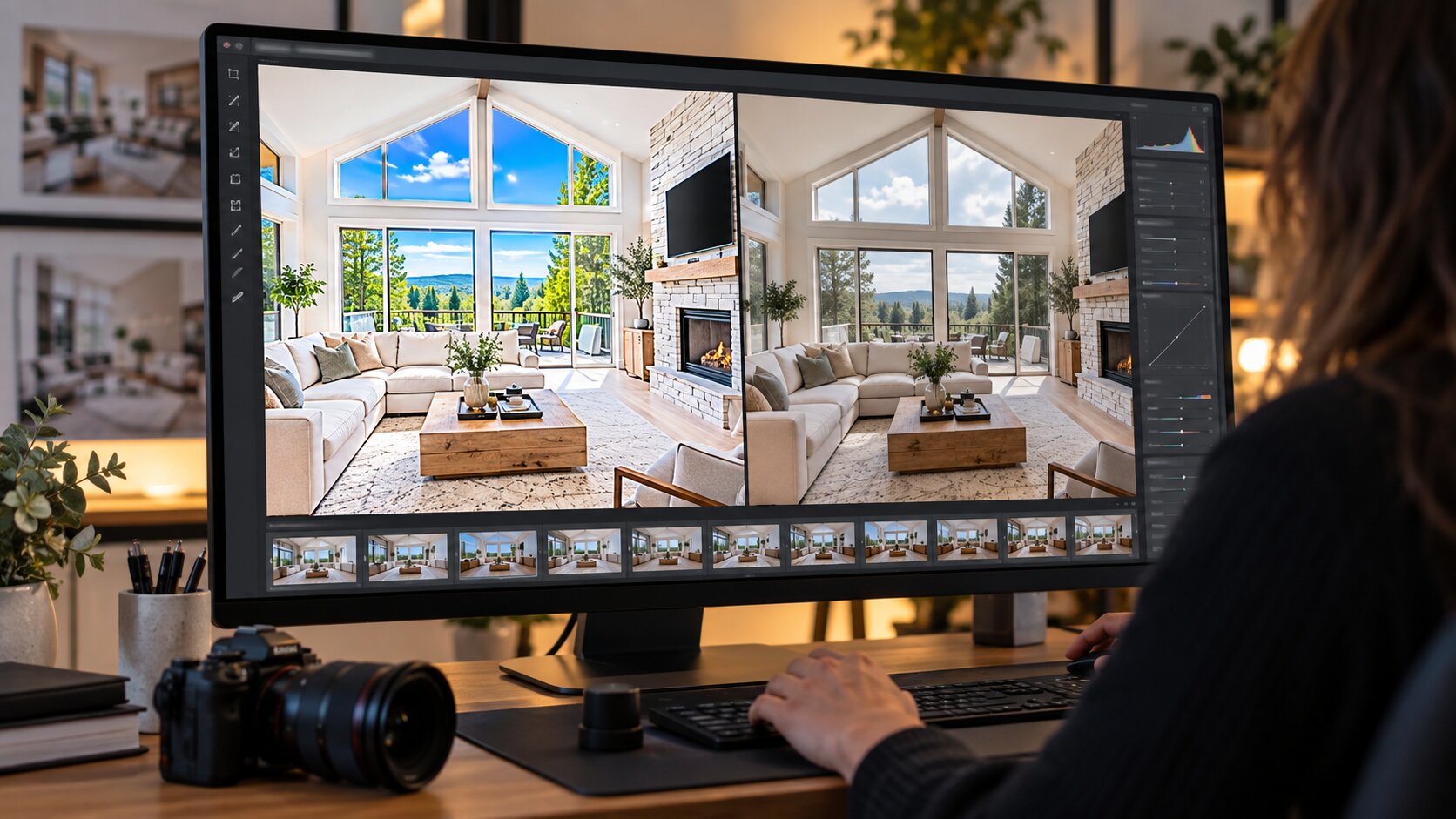
02 Nov AI vs. Professional Real Estate Photo Editing: What’s the Difference?
| TLDR; AI real estate photo editing tools are good at fast, routine corrections. They will brighten a dim room or straighten a crooked shot in seconds. Where they still struggle is the judgment calls that need someone who knows what the room looked like in person. That is where a human editor, working from the photographer’s own notes, makes a difference you can see in the final image. |
Barely a year ago, AI editing was something relatively new that photographers used mostly among themselves, but now the tools are marketed straight to agents and sellers. You have probably seen the ads for various AI real estate photo editing services doing the rounds.
The proposition is always the same: agents are invited to upload a phone photo and receive a bright, blue-sky listing image in seconds, with no photographer booked.
The way in which it is presented it almost looks quite effortless, and while some of that marketing is fair, a great deal of it isn’t. AI has definitely become quick and cheap at the routine parts of editing, but the service neglects to mention what happens to a photo between the shoot and the listing, and where an automated filter hits its limits. Those limits, by the way, are really quite glaring.
Having said that, this blog post is definitely not a case against AI, a remarkable technology that I believe has many excellent uses. It is about what to expect from each approach – both traditional real estate photo editing and the latest AI service – so you can tell the difference when you are the one booking the shoot.
Key Takeaways
- AI tools are fast and capable at routine fixes, like basic brightness and color correction, cropping, and simple retouching.
- Human editors still do better on judgment-heavy work, like matching a window’s true light, blending exposures naturally, and catching an artifact before it goes out.
- The real risk with AI editing is rarely one bad edit. It is the missing review step that would have caught a mistake before delivery.\
- At Home Media’s editing is done by a person reviewing every image, not pushed through an automated filter.
What AI Photo Editing Tools Actually Do Well
I should give AI credit where it is due. For the routine parts of a photo edit, the tools are quick, cheap, and steady. Impressively so, actually.
Speed is the obvious one, as an AI tool can brighten, straighten, and color-correct a full set of images in the time it takes to make a coffee. For a high-volume agent who needs a rental listing up the same afternoon, that turnaround is worth a lot, and the appeal is obvious.
Cost is the next benefit, with many of these tools running on a low monthly fee or a few dollars per image (well under a full editing service), and that definitely counts for something on a tight photography budget.
Then we have consistency, which is a benefit of AI real estate photo editing that many agents overlook. If you were to run fifty photos through the same tool, they will all come back with the same crop ratio, white balance, and baseline brightness. That evenness is quite useful, and software handles that kind of repetitive correction better than a tired human late in the day, regardless of how experienced he or she may be.
Now, for plenty of routine, everyday listings, they are good enough reasons to sign up, and it’s why AI now does much of the groundwork behind tools like virtual staging.
Where AI Still Fails in Real Estate Photography

The drawbacks are quite damaging, though.
The glaring difference between a human editor and an AI tool is demonstrated the moment a photo needs a decision rather than a correction, and HDR blending is the clearest example of that. With the latest AI tools, for example, a real estate interior gets shot as a stack of bracketed exposures, from dark to bright, then combined so the room and the view through the window both come out right.
AI can merge those frames, but it tends to overcook the result, leaving haloed edges, gray skies pushed to an odd electric blue, and shadows lifted until the room goes flat. A person editing the same set blends toward what the room looked like to stand in, which was the reason for the photo.
Where the Blend Gets Made
Window pulls run into the same wall, because exposing for the interior turns the view outside to white, and recovering it so the garden or skyline reads as a believable exterior is a judgment about how bright the window should sit.
Then again, lean on it too hard and you get a sharp outdoor scene behind a dim room, the sort of image a buyer senses is off without being able to say why. That is the kind of call handled well across our luxury real estate photography, where every frame gets studied.
The step AI skips
Most of the AI conversation fixates on individual edits, but the thing that actually goes wrong is quieter than one bad frame. With a fully automated pipeline, nobody looks at the set before it reaches the listing.
A person editing by hand spots the frame where a plant has been cloned into a doorway, or a wall straightened until the ceiling line bends, and pulls it first. Software has no sense of its own errors, so whatever it gets wrong ships.
AI vs. a Human Editor Comparison
| Task | AI Handles Well | Where a Human Editor Still Matters |
| Brightness and color correction | Fast, consistent across a batch | Matching the light the room actually had |
| Cropping and straightening | Reliable on standard shots | Framing for the feature that sells the room |
| HDR exposure blending | Can merge brackets quickly | Keeping the blend natural, not over-processed |
| Window pulls | Basic recovery of a blown-out view | A believable exterior that matches the interior light |
| Sky replacement | Swaps a gray sky in seconds | A sky that suits the season and the house |
| Final review | No self-check for its own errors | Catching an artifact before the client sees it |
What This Means for Your Listing Photos

You do not need to take a side in the AI argument (unless you want to, of course). With AI real estate photo editing now sold straight to agents, you mainly need to know what you are paying for, and what to ask when you book.
Most real estate photo editing services look similar from the outside, so the question you need to ask is quite simple: Does a person review every image before it gets to me, or not?
What to Ask Before You Book
Ultimately, a service that leans on automated editing with no human check is faster and cheaper – and for some listings that’s fine, but for a property where the photos carry the sale, you really need someone who has looked at every single frame, diligently, and studiously, with real experience in the craft of real estate photography.
It is also worth asking how the editing is done, because a service confident in its process describes it plainly, without gimmicks or patter, including how it blends exposures and how it handles a blown-out window. On a higher-end property, those details show in the final set, so the editing process is fair to ask about before you book.
See How Your Photos Are Edited
AI editing has a real place, and for plenty of listings the speed is worth it. For a property where the photos do the heavy lifting, the edit is worth a closer look. At Home Media edits every shoot by hand, with a person reviewing each image before it goes out.
See the editing process behind every shoot. View our real estate photography services and book your next shoot with Anthony.
FAQ
Is AI real estate photo editing as good as professional editing?
For routine fixes it is close, often fast enough that the difference does not show. On judgment-heavy work, like natural HDR blends or believable window pulls, a human editor still has the edge. The call depends on knowing what the room looked like.
Does At Home Media use AI in its editing process?
Every image is edited and reviewed by a person. The HDR blending, sky replacement, window pulls, and virtual fire where used are done by hand, with a human checking each frame before it goes out, not run through an automated filter.
What's the risk of using fully AI-edited listing photos?
The main risk is the missing review step. With no person checking the set, a cloned object or a warped wall can slip through to the listing before anyone notices.
Can AI editing make a photo misleading?
It can, sure. An over-processed sky or an over-recovered window can show a property looking brighter or grander than it is. That sets a buyer up for disappointment at the showing. Good editing keeps the image true to the home, the same principle behind a good twilight real estate photography shot.

Sorry, the comment form is closed at this time.