
17 Sep Best Camera for Real Estate Photography
Most property listings live or die by their photos. Buyers scroll through dozens of homes online in minutes, and a blurry, poorly lit image is all it takes to lose their attention permanently.
Choosing a professional camera setup is a massive hurdle, both for your schedule and your bank account.
It’s a high-stakes business investment where the wrong lens or a cheap sensor can make a million-dollar home look like a basement apartment. Navigating the specs, the glass, and the lighting gear is a full-time job in itself.
That’s exactly why most top-tier agents skip the gear hunt entirely. While we’ve built this guide to help you understand the tech, the most efficient way to get the wow-factor results is simply to hire a pro from At Home Media.
The Undeniable Impact of Quality Real Estate Photography
Listings with professional-quality photos consistently attract more online views than those without.
The National Association of REALTORS® reports that more than half of buyers find their homes online, which means the photos are selling before any agent ever picks up the phone. A sharp, well-composed image of a living room communicates scale, light, and lifestyle in a single glance.
The consequences of poor photography go beyond aesthetics. Properties photographed with low-quality images tend to sit on the market longer and often receive lower initial offers.
Buyers anchor their perceived value to what they see first. If the photography looks amateur, many will assume the property is overpriced or has hidden problems.
Good interior shots do the opposite. When the light looks right, the proportions read true, and the finishes are actually visible, buyers start picturing themselves in the space before they’ve seen it in person. That’s what gets people through the door – and viewings are where offers come from.
What Makes a Camera Most Suitable for Real Estate?
Not every camera is built for the specific demands of interior photography. Real estate shooting environments are notoriously challenging: rooms with bright windows competing against dim interiors, or tight spaces that require ultra-wide focal lengths don’t make the task any easier. Here’s what actually matters.
Sensor Size
A full-frame sensor pulls in more light, which matters most in the rooms that need it – dark corners, tricky mixed lighting, spaces that don’t photograph easily. The detail that cheaper sensors lose is usually exactly what buyers are trying to see.
APS-C (crop sensor) cameras are smaller and more affordable, and many produce excellent results, but full-frame bodies give you a real edge in challenging interiors.
Dynamic Range
Dynamic range refers to a camera’s ability to capture detail in both the bright and dark areas of a scene simultaneously. In a room where sunlight pours through a window while the far wall sits in shadow, high dynamic range means you retain both. Cameras from Sony, Nikon, and Fujifilm have historically led in this area.
Low-Light Performance
Not every property photographs easily. Basements, north-facing rooms, and evening shoots are part of the job, and a camera that falls apart above ISO 800 will show it.
Something that handles ISO 1600 (or higher) cleanly gives you enough flexibility to work with what you’ve got rather than waiting for conditions that may not improve.
Manual Control and Lens Compatibility
Aperture, shutter speed, ISO – you need full control over all three. Real estate interiors change too much from room to room to leave decisions to the camera.
Lens compatibility is worth thinking about early, too. Wide-angle glass is essential, and a system with good third-party options keeps costs from stacking up as your kit grows.
Full-frame sensors tend to handle low light and dynamic range better than crop sensors – worth considering for interiors where bright windows and shaded walls are competing in the same frame.
Best Cameras for Real Estate Photography — By Budget
Truth is, there isn’t some “magic” camera that works in every single case. Your choice will come down to three things: how much cash you’re willing to drop, your comfort level with tech, and just how busy your listing schedule actually is.
To make things easier, I’ve rounded up the heavy hitters at three price levels – balancing traditional DSLRs with newer mirrorless setups.
Starting Out – Best Value for New Photographers
If you’re moving up from a smartphone or buying your first dedicated body, you don’t need to spend a lot to get something genuinely capable.
Canon EOS Rebel SL3
One of the lightest DSLRs on the market, the SL3 features a 24.1-megapixel APS-C sensor, solid autofocus, and excellent compatibility with Canon’s EF and EF-S lens lineup. Its flip-out touchscreen is genuinely useful for composing low-angle shots in tight spaces. It’s beginner-friendly without feeling limited.
- Pros: Lightweight, intuitive menu system, wide lens ecosystem, good JPG output straight from the camera
- Cons: Crop sensor limits low-light ceiling, no weather sealing
Nikon D3500
This camera is built around a 24.2-megapixel sensor that still holds its own, especially with Nikon’s knack for getting colors to look right.
The real kicker here? The battery life is insane. You can go through multiple shoots on a single charge while your mirrorless friends are hunting for a power outlet.
Plus, if you’re shooting at base ISO, the files are surprisingly clean – honestly, they look as good as stuff from cameras that’ll cost you twice as much.
- Pros: The battery just keeps going, the colors look “real,” and it’s got a built-in guide for anyone still figuring out manual mode
- Cons: That rear screen is bolted in place (no articulating), you’re stuck with 1080p video, and the autofocus feels a bit like a relic from 2015
Sony a6100
If you’re over the bulky DSLR Vibe, the a6100 is the logical jump into the mirrorless game. It’s tiny, fast, and gives you a foot in the door with Sony’s APS-C line.
To be honest, the fancy eye-tracking AF is totally useless for a static dining room shot, but the sheer image quality makes up for it. The biggest selling point, though, is the glass. You get access to those ultra-wide E-mount lenses that are basically mandatory for making small bathrooms look huge.
- Pros: Snappy AF, super portable, and compatible with almost any Sony lens
- Cons: It chews through batteries, and the internal menus are a disorganized mess that’ll take a few days to learn
Mid-Range Picks – For Regular Shooting
If you’re covering multiple listings a week or building real estate photography into a serious side income, this tier is where image quality and shooting speed start to feel noticeably different.
Nikon Z5 II
A full-frame mirrorless body at a price that doesn’t match what it delivers. The 24.5-megapixel sensor handles mixed interior light well, in-body stabilization helps in tighter spaces, and the dynamic range holds up when windows and shadows are competing in the same frame. The Z-mount has solid wide-angle options too.
- Pros: Full-frame sensor, IBIS, strong dynamic range, weather sealing
- Cons: Smaller lens selection than Canon or Sony at the same price point
Sony a7C
Popular with real estate photographers who move between properties and don’t want to carry a heavy kit. The full-frame 24.2-megapixel sensor produces files that hold up in post, and Sony’s FE lens catalog — wide-angle options included – is one of the deepest available.
- Pros: Compact full-frame build, excellent dynamic range, extensive lens ecosystem
- Cons: Single card slot, minimal physical controls for a full-frame body
Fujifilm X-T5
Forty megapixels on an APS-C sensor produces files with more detail than most real estate shoots will ever need – which means serious cropping flexibility.
Fujifilm’s color rendering is genuinely distinctive, and the film simulations can trim post-processing time if you lean into them. The crop factor means you’ll need specific glass for interiors, but the XF 10-24mm handles most spaces well.
- Pros: Very high resolution for an APS-C body, strong color science, compact
- Cons: Crop sensor, fewer native ultra-wide options than full-frame systems
Professional Powerhouses: High-End Cameras for Uncompromising Quality
These are the tools used by full-time real estate and architectural photographers. The investment is substantial, but so is the quality of the output.
Sony a7R V
With a 61-megapixel full-frame sensor, the a7R V produces files with resolution that lets you crop aggressively without loss of detail.
Dynamic range is a standout here – mixed interior lighting that would cause problems with other bodies is a non-issue. The autofocus is fast enough that moving between rooms quickly doesn’t cost you sharp frames. For listings where the photography has to be at its best, it holds up.
- Pros: Top-tier resolution, incredible dynamic range, a scary-fast AF system, and a build that’s weather-sealed for those rainy exterior shots.
- Cons: The massive files will chew through your storage and bog down a slow computer, plus you’re definitely paying a premium for the power.
Canon EOS R5
Canon’s flagship mirrorless body combines a 45-megapixel full-frame sensor with superb color accuracy and Canon’s reliable, intuitive ergonomics.
The dual card slots and excellent battery life make it practical for heavy professional use, and the RF lens system includes some outstanding wide-angle options for interior work.
- Pros: Excellent resolution and color, dual card slots, strong video capabilities, RF wide-angle lens options
- Cons: High body cost, large RAW files
Nikon Z8
A near full-feature flagship at a step below the Z9’s price, the Nikon Z8 brings 45.7 megapixels, a stacked BSI sensor with superb low-light output, and class-leading dynamic range to the table.
For real estate photographers who also shoot video for listing tours, the Z8’s video capabilities are hard to match.
- Pros: Outstanding dynamic range and low-light performance, no mechanical shutter needed, excellent video
- Cons: Premium price, smaller Z-mount lens catalog compared to Canon and Sony
Mirrorless vs. DSLR: Which is the Best Camera for Real Estate Photography Today?
This debate has largely settled in favor of mirrorless cameras for new purchases. They offer electronic viewfinders that display the exposure before you take the shot, which significantly speeds up the workflow on location.
They’re also generally more compact, and the latest generations from Sony, Canon, and Nikon have closed any previous gaps in battery life and lens selection.
DSLRs still have a strong argument for agents working with existing gear. The lens libraries are vast, used bodies are affordable, and battery life on many DSLRs still outpaces mirrorless equivalents. If you already own a Canon or Nikon DSLR system with wide-angle glass, there’s no urgent reason to switch.
For anyone buying new in the current market, mirrorless is the better long-term investment. The manufacturers have clearly committed to mirrorless as their primary development platform, and the lens ecosystems are maturing rapidly.
Lenses for Real Estate Photography
The lens matters more than most photographers expect — a sharp wide-angle on a budget body will produce better interior shots than a soft lens on an expensive one. It’s worth getting the glass right first.
Wide-Angle Zooms
The 16-35mm range is where most full-frame real estate photographers spend their time. The Sony FE 16-35mm f/2.8 GM, Canon RF 15-35mm f/2.8L IS USM, and Nikon Z 17-28mm f/2.8 are well-worn choices for good reason.
On APS-C, you’re looking at 10-22mm to get a similar field of view. Fujifilm’s XF 10-24mm and Canon’s EF-S 10-18mm are both capable and won’t drain the budget.
Wide-Angle Prime Lenses
A 20mm, 24mm, or 28mm prime on full-frame will typically be sharper than a zoom at the same price, and the wider maximum aperture helps in low-light rooms.
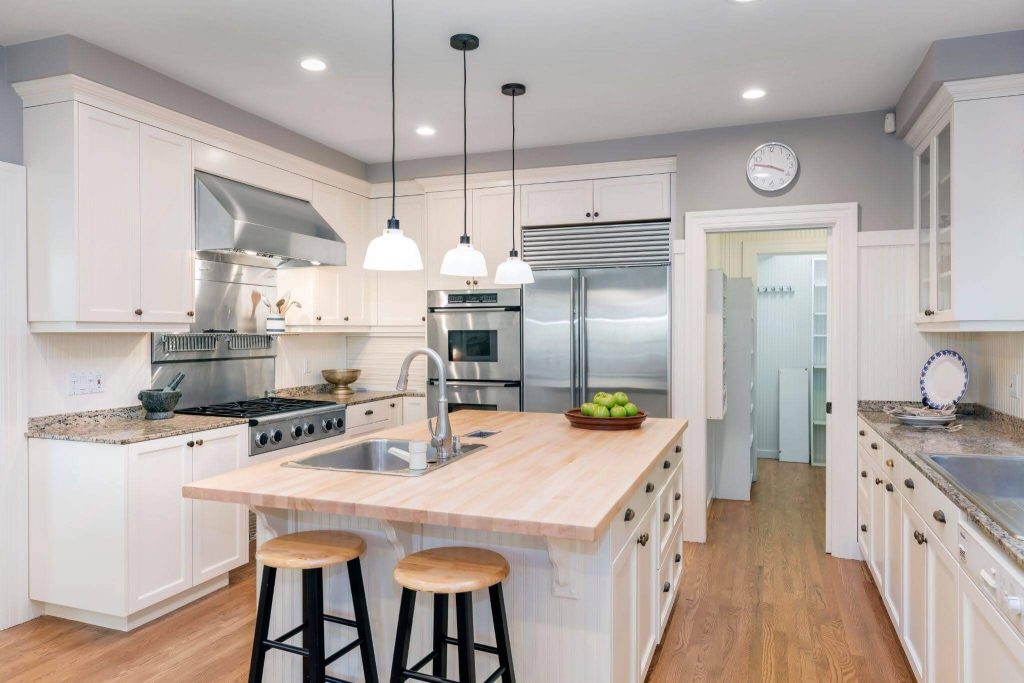
They’re excellent for hero shots of open-plan spaces and kitchens where maximum sharpness and corner-to-corner detail matter most. The Sony FE 24mm f/1.4 GM and Sigma 20mm f/1.4 Art are standouts in this category.
Tilt-Shift Lenses
Used by architectural photographers to correct converging verticals without extensive post-processing, tilt-shift lenses are a specialty purchase. They’re not essential for most real estate work, but become valuable for high-end listings where precise geometric correction is expected.
Keep in mind: A high-quality wide-angle lens is often more impactful than an expensive camera body for capturing spacious real estate interiors. Prioritize glass investment early in your gear journey.
If you’re not sure where to start with lens selection for a specific camera system, it’s easiest to invest in professional real estate photography services from At Home Media for excellent results with no effort on your part (and without buying advanced equipment).
Gear and Technique – Getting the Most From Your Camera
The camera body is only part of the picture. Without the right supporting equipment, even a well-specced body produces results that fall short. The items below aren’t extras – they’re what make the difference between average and consistent work.
Tripod
Slower shutter speeds are common in interior work because natural light needs time to register properly. Any movement during exposure shows up in the final image.
A sturdy tripod solves that, and it has a secondary benefit – it slows you down enough to think carefully about framing and leveling before you shoot. Manfrotto covers the mid-range well; Really Right Stuff is the step up for professional use.
External Flash and Lighting
On-camera flash flattens a room and rarely looks good. An off-camera flash bounced off a ceiling or wall produces light that feels more like it belongs in the space. Placed well, a couple of speedlights can make an ordinary interior look genuinely inviting.
The flambient technique (blending ambient exposure with flash frames during editing) has become a standard approach for real estate photographers seeking consistent, natural-looking results.
Remote Shutter Release
Pressing the shutter button by hand introduces vibration, even on a tripod. A wired or wireless remote release removes that entirely. It’s inexpensive, and the improvement in sharpness at slower speeds is noticeable.
Post-Processing Software
Adobe Lightroom handles most of what real estate editing requires, including lens correction, exposure adjustment, and highlight and shadow recovery. It’s widely used because it works reliably across a high volume of images.
Capture One is the main alternative, with color handling that suits photographers who want more control – particularly popular with Fujifilm users who want to get the most out of the camera’s color science.
Partner with At Home Media for Stunning Real Estate Photography
Ground-level photography, even when executed perfectly, tells only part of a property’s story.
Let’s be honest: some properties just don’t make sense from the driveway. You can’t capture the sheer scale of a massive backyard, the way the roofline hits the light, or how close the water actually is with a standard tripod.
Ground-level shots have their limits—they miss the big-picture neighborhood context. That’s where you need a bird’s-eye view to show people exactly what they’re buying into.
That’s where professional aerial photography can entirely change the narrative for a listing.
We’ve built our offer specifically for real estate professionals in Westchester County and the surrounding region.
With an FAA-licensed drone operator and a skillful ground photographer, you will be able to capture the kind of sweeping, high-resolution images that position a property above the competition on any platform.
Strong interior photography and aerial footage together give buyers a complete read on a property, covering the space itself and how it sits in its surroundings. That combination tends to produce more serious inquiries and viewings from people who already know what they’re coming to see.
If you want to talk through how professional photography and drone coverage could benefit your listings, get in touch with At Home Media.

No Comments